
Spanaway Previous Resident Sources
A sound house history separates transfer evidence from household evidence. The Pierce County Auditor documents recorded parties and instruments. Directories and census schedules can place people at an address, while PALS and the Buildings Index can date work on the structure. Coverage differs, and an online date range never means older records ceased to exist.
| Source | Period documented | Custodian or access point | What it can establish |
|---|---|---|---|
| Current recorded documents | Modern recordings; exact ARM start not stated | Pierce Auditor ARM and counter | Parties, instrument dates, legal descriptions, related records |
| Digital land index | 1984-2014 detailed series range | Washington Digital Archives | Grantor/grantee entries, types, dates, addition terms |
| Tacoma Suburban directories | Spanaway 1974-75 and 1977-84 | Washington State Library | Printed name, address, and household clues where present |
| Federal census | Public schedules through 1950 | HeritageQuest and archive/library routes | Household members and locality at the census date |
| Buildings Index | Local building-news index described from 1883-1950, with later address entries | Tacoma Public Library Northwest Room | Builders, prior addresses, news, dates, photos, directory citations |
| Permits and plans | PALS has more than 30 years in project materials; exact Spanaway start unknown | Pierce Planning and Public Works | Work location, application, status, plans, project parties |
Start with the source closest to the time in question. For a recent transfer, use ARM and certified-copy routes. For a mid-century household, combine the directory shelf, census, newspapers, and building index. Earlier work may require deed books, plats, probate, church sources, or Puget Sound Regional Archives.
Fix the Spanaway Parcel First
Before searching for past residents, confirm that the present address points to the right parcel. ATIP Parcel Search and PublicGIS provide the parcel number, site address, plat, and assessment context. Keep the taxpayer mailing field separate from the physical site. A mailing address may belong somewhere else, and the taxpayer name is not a guaranteed title statement.
Copy the legal description or plat, lot, and block when available. Those descriptions often survive a street-name or number change. PublicGIS boundaries are approximate, so a clicked shape is a navigation aid rather than a survey. If the address returns several parcels, compare the map, site field, plat, and recorded instrument before proceeding.
Spanaway's unincorporated status also determines custody. Most local property and permit records run through Pierce County. A Tacoma postal line on a service location does not turn the record into a Tacoma municipal file.
Note: Record the date viewed alongside the parcel number, since tax values and taxpayer fields can change over time.
Reverse the Pierce Deed Chain
The deed chain identifies successive recorded ownership events. It does not automatically identify every person who lived in the building. Start with today's parcel and the most recent purchase instrument, then walk each seller backward through earlier acquisitions.
- Find the current parcel in ATIP and preserve the site address, parcel number, plat, and legal description without treating the taxpayer field as final title proof.
- Open Pierce ARM and search for the current party, parcel link, legal description, or a narrow date span. Note instrument type and recording number.
- Read the purchase deed. The grantee received the interest; the grantor transferred it. Search that grantor's and grantee's prior roles carefully.
- Repeat the sequence backward. Compare legal descriptions so a same-name person or unrelated parcel does not enter the chain.
- For the archive window, use the Digital Archives index. For older gaps or restricted images, contact the Auditor counter or archives for the specific book, instrument, or copy.
- Grantor
- The person or entity transferring an interest in the recorded instrument.
- Grantee
- The person or entity receiving that interest.
- Chain of title
- The sequence of recorded transfers tied to one legal property description.
- Legal description
- The lot, block, plat, metes-and-bounds, or other land wording that identifies property more firmly than a street label.
A deed index is only an index. ARM warns that parcel-linked documents can be incomplete and only title work can determine vested interest. Order a certified copy when an authenticated record is needed.
Spanaway's Digital Deed Window
The Washington Digital Archives Pierce land records collection gives a stable historical search form. Its detailed description reports 8,067,022 indexed records for 1984 through 2014. Search by Party Last or Company, First, Middle, optional Soundex, Keywords, Addition Name, and year range. Browse mode can help when a name is uncertain.
The captured Pierce land-record series entry shows the official route used for grantor and grantee research.
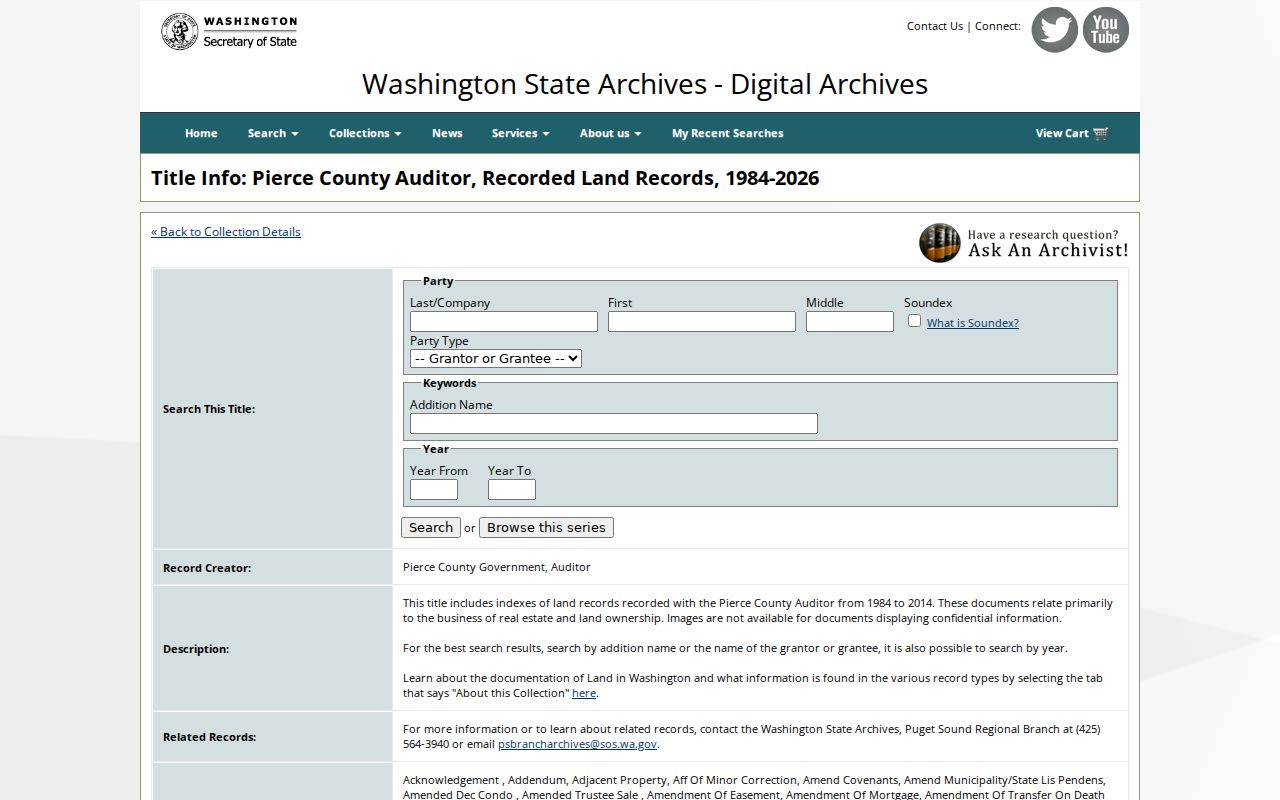
Do not convert the archive range into a claim that Pierce land records began in 1984. County deeds are much older. The digital series is one access layer, while the county counter, State Archives, Puget Sound Regional Archives, microfilm, and deed books serve earlier research. ARM images may be redacted, and restricted images need a written request and payment route.
At the Auditor counter, appointments are recommended and walk-ins may be standby. Certified photocopies are listed at $3 for the first page and $1 for each later page; uncertified copies are $1 per page, and record searches are $8 per hour. Check the current fee page before ordering.
Spanaway Households Between Census Years
Deeds track property interests, not all past residents. Printed directories can fill years between federal censuses and may place a householder, spouse, occupation, or phone at an address. Washington State Library holdings specifically list Spanaway within Tacoma Suburban volumes for 1974-75 and 1977-84. Current State Library access has been limited since July 2025, so verify appointments and use Pierce County or Tacoma library alternatives when needed.
A practical pairing process keeps the evidence in order:
- Choose a target census year and retrieve the household from a library database or archive source.
- Check the nearest available directory years before and after it, using the address and surname indexes that the volume provides.
- Transcribe the entry exactly, including spouse markers, occupation abbreviations, phone, and address. Do not infer facts the key does not define.
- Compare names with deeds, obituary citations, marriage records, probate, and naturalization only within the relevant dates.
- Write down absences as gaps, not proof that a family left. Coverage and publication can vary by year.
The Parkland/Spanaway Library offers computers, copying, scanning, microfilm or microfiche readers, obituary-request help, HeritageQuest, HeritageHub, and Ancestry Library Edition onsite. Tacoma Public Library adds the Northwest Room, obituary index, local newspapers, and Buildings Index. For details on the printed collection itself, consult the Spanaway city directory collection.
Spanaway Buildings Name Their Past
Tacoma Public Library's Buildings Index can connect one Spanaway address to a construction item, former street name, architect, contractor, photograph, plan, newspaper citation, or directory note. Use the local history and genealogy portal as the entry point, then follow each citation to its underlying directory or news item.
The Leroy Sanders Residence at 524 160TH ST E is a rich example of record convergence. The index describes an 1896 build, a purchase around 1906, a link to Tacoma Times editor Leroy Sanders, a Washington State Register date in 1984, and a later use beginning in 2011. Those facts form a research path, not a full roster of previous residents. The next checks are the cited newspapers, parcel and plat, recorded parties, and directory years.
Other entries offer narrower anchors. A Military Road property points to Edward G. and Evelyn Bucsko in a 1959 city directory. An address on 152ND Street carries a 1963 fire note, which suggests a focused permit and newspaper search for rebuilding. Permit-news citations from 1967 and 1968 can date construction even when a deed says little about the building itself.
Previous Residents Behind Louvre Street
An address change can break a backward search even when the parcel never moved. The Buildings Index entry for 102 153RD ST S says the site was formerly Louvre St. So. and notes an address change around 1986. Run both address strings in directory indexes, newspaper databases, permits, and local-history catalogs. Then use the parcel's legal description and plat to prove continuity.
This Spanaway quirk is especially important near the Tacoma Suburban directory period. A volume may reflect the old road name while ATIP displays the modern site address. ZIP and postal city labels can also differ: official examples use both 98387 and 98444 in the Spanaway area, sometimes with Tacoma as the mailing city. USPS data is a delivery fact, not a parcel boundary or proof of residence.
No comprehensive Spanaway street-renumbering ordinance was found in the official sources. Treat the Louvre example as a documented bridge, not proof that every local road changed in the same year.
Spanaway Plats Before Street Names
Older property may appear under an addition, lot, block, or survey long before the current address became its common label. Washington Digital Archives describes Pierce plats and surveys from 1973 and 1984-2026 series ranges. Search fields include party or company name, Soundex, party type, addition, and year range. Plats, short plats, condominiums, surveys, and boundary records can explain how a current parcel was formed.
Carry the plat identity into PALS. The online permit search supports an address or parcel path, but its exact earliest Spanaway coverage was not located. Missing material can be requested from Planning and Public Works. A useful request names the site address, parcel, record type, and date range instead of asking for every file about a place.
For nineteenth-century land, shift to county deed books, donation land claims, probate, naturalization, church records, newspapers, and archives. Pierce County's early recordkeeping contains gaps and later renumbering, so modern portal silence is not proof that no record survives.
Close Spanaway Previous Resident Trails
An obituary can link a named person to relatives, a former community, or a funeral notice. Probate may explain why a parcel passed to heirs or an estate. Marriage, death, and naturalization indexes can distinguish people with similar names. Use each as a dated endpoint and confirm it against the original custodian when possible.
Tacoma Public Library offers an obituary index and newspaper help, while Pierce County court files route through the Clerk. LINX describes public filed documents from 2002 forward, a request path for 1991-2001 scans, and Clerk research for pre-1991 cases. Early probate and other hard-copy material may be at Puget Sound Regional Archives, with microfilm at State Archives Olympia. These channels matter because previous residents often leave their last clear address in a probate or death-related source rather than a property portal.
Keep the finished timeline modest: date, address form, name as printed, relationship to the property or household, source, and confidence note. A matching surname alone is not enough.
Keep house history personal and lawful. Never use a previous-resident trail to locate, pressure, harass, or harm a living person. Respect sealed, restricted, and protected address records.